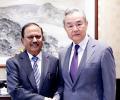
Wang is travelling to India days ahead of Prime Minister Narendra Modi's planned trip to the Chinese city of Tianjin to attend the annual summit of the Shanghai Cooperation Organisation.

As Iran heads into crucial peace talks with the United States of America, here are the six men who decide the Islamic Republic's course.

The Indian government has convened an all-party meeting to discuss the ongoing crisis in West Asia, following Prime Minister Modi's address to Parliament on the situation and its potential impact on India.
When asked whether both armies talked to each other, initiated by the Pakistani army, Jaishankar said, "Yes, we have a mechanism to talk to each other as a hotline. So, on the 10th of May, it was the Pakistani army which sent a message that they were ready to stop firing, and we responded accordingly."

'The West Asia or the Gulf crisis has shown that what we develop as national infrastructure when things are not as bad as they could be, we forget to plan for adversities.'

Prime Minister Narendra Modi convened the Cabinet Committee on Security to address the impact of the West Asia conflict on Indian citizens, focusing on safeguarding them from the conflict's effects and ensuring the smooth flow of essential supplies.
Jaishankar said the UN Security Council condemned the attack and underlined the need to hold perpetrators, organisers, financiers and sponsors of the reprehensible act and bring them to justice.

The security cover of External Affairs Minister S Jaishankar has been strengthened with the addition of two bullet-resistant vehicles following a review of his Z category armed central protection recently, official sources said on Wednesday.

Congress leader Rahul Gandhi on Friday accused External Affairs Minister S Jaishankar of "collapsing" India's foreign policy and questioned the government's handling of the recent tensions with Pakistan, particularly the US President Donald Trump's role as a mediator. Gandhi's remarks come amidst a war of words between the Congress and the ruling BJP over their leaders' statements on the Indo-Pak conflict.

India expects partners to understand its policy of 'zero tolerance' against terrorism, and it will never countenance 'perpetrators of evil' being put on par with its victims, External Affairs Minister S Jaishankar said on Saturday during extensive talks with his British counterpart David Lammy.

External Affairs Minister S Jaishankar has informed a parliamentary panel that Pakistan was notified about Indian strikes on terror camps in their territory only after they were carried out. He also clarified that the decision to halt the military operation was taken bilaterally following a request from Pakistan, and there was no US mediation involved. Jaishankar emphasized India's zero-tolerance policy against terrorism and the importance of conveying a united message against it globally.

The US President had hosted Modi for an official working visit in Washington, DC, on February 13 last year.

He added that opposition parties were assured that their concerns regarding the impact of the West Asia situation on India and the safety of Indian citizens were addressed in detail.
External Affairs Minister S Jaishankar is scheduled to visit China for an SCO conclave, marking a significant step in easing tensions after the 2020 border standoff. Discussions on the boundary dispute are also anticipated.
To be sure, Trump is furious, as the trajectory of the war is in a state of Zugzwang, as chess players call it. Trump and Netanyahu stare at two choices -- retreat in humiliation and concede Tehran's demands -- recognition of its rights, reparations, and binding security guarantees -- or perish in a quagmire, points out Ambassador M K Bhadrakumar.
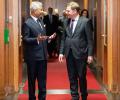
External Affairs Minister S Jaishankar has asserted that India has zero tolerance for terrorism and will never give in to nuclear blackmail, emphasizing that New Delhi will deal with Pakistan purely bilaterally. He made these remarks during a joint press conference with his German counterpart in Berlin, where he also highlighted the importance of the strategic partnership between India and Germany, emphasizing the need for a free trade agreement between the two nations.

"India has consistently maintained a firm and uncompromising stance against terrorism in all its forms and manifestations. It will continue to do so," he said.
Jaishankar said that the Pahalgam attack "was an act of economic warfare. It was meant to destroy tourism in Kashmir, which was the mainstay of the economy. It was also meant to provoke religious violence because people were asked to identify their faith before they were killed."

After the war erupted between Russia and Ukraine, the US and Western nations imposed sanctions on Moscow. However, India has continued to purchase Russian oil.

Prime Minister Narendra Modi stayed calm, avoided public confrontation, and focused on India's long-term interests to steady ties with the United States.

What we are watching is something different: A fog manufactured and maintained by the people who started the war, so that the question of why it was started never has to be answered, observes Prem Panicker in his must read blog on the war in the Middle East.
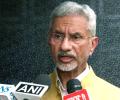
India on Thursday welcomed Kabul's firm rejection of attempts to create distrust between India and Afghanistan during a phone conversation between External Affairs Minister S Jaishankar and acting Afghan Foreign Minister Amir Khan Muttaqi.

The Ministry of External Affairs (MEA) has confirmed the deaths of six Indian nationals and one missing person amidst the escalating conflict in West Asia, detailing ongoing efforts for repatriation and diplomatic engagement.
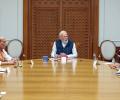
Prime Minister Narendra Modi will chair a meeting of the Cabinet Committee of Security (CCS) in Delhi to discuss the global situation following the attack on Iran and the killing of Iranian Supreme Leader Ayatollah Ali Khamenei.
Jaishankar said such a description would be like putting the perpetrator and the victim of the Pahalgam attack at the same level.

The meeting comes in the wake of the terrorist attack in Jammu and Kashmir's Pahalgam on Tuesday in which 26 men, mostly tourists and including a Nepalese citizen, were gunned down in cold blood.

Union Home Minister Amit Shah is expected to respond to the debate on the no-confidence motion against Lok Sabha Speaker Om Birla, following allegations of partisan conduct. The motion, moved by opposition members, questions Birla's impartiality and handling of House proceedings.

He said Prime Minister Narendra Modi has made it "very clear" that any talks with Pakistan will be only on terror.

The Cabinet Committee on Security (CCS) has reviewed the evolving situation in West Asia, directing departments to assist Indian nationals affected by recent developments and emphasizing the need for dialogue and diplomacy.

A public exchange of open letters between Congress leaders Mani Shankar Aiyar and Shashi Tharoor reveals a significant rift over foreign policy, particularly concerning Israel and the Sabarimala temple issue.

External Affairs Minister S Jaishankar discusses India's foreign policy challenges in a multipolar world, emphasizing the need for nimbleness and prioritizing national interests.

Indian External Affairs Minister S Jaishankar and his Canadian counterpart Anita Anand held their first phone conversation, focusing on strengthening bilateral economic ties and advancing shared priorities. The call comes amid efforts to repair relations between the two countries, which had been strained under the previous Canadian government. Both ministers expressed their commitment to improving ties and working together on areas of mutual interest. The conversation follows a period of tensions stemming from allegations of Indian involvement in the killing of a Sikh activist on Canadian soil.

24 Indian-flagged vessels with 677 Indian seafarers were currently located west of the Strait of Hormuz, and four vessels with 101 Indian seafarers were stationed east of the strategic waterway.

External Affairs Minister S Jaishankar has said the recent confrontation between India and Pakistan was not just a mere conflict between two neighbours, but it was about combating terrorism, which will eventually come back to haunt the West.
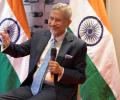
'As far as I'm concerned, how effective the Rafale was or frankly, how effective other systems were -- to me, the proof of the pudding is the destroyed and disabled airfields on the Pakistani side'

Amid escalating tensions, Iranian Deputy Foreign Minister Saeed Khatibzadeh declares Iran's unwavering commitment to a 'heroic nationalist defence' against perceived American and Israeli aggression, vowing to resist what he calls an 'invasion' to the very end.

'Was the five-day pause ever meant to hold, or was it simply another instrument of signaling, of positioning, of buying time in a war where even the pauses are tactical?' asks Prem Panicker in his must read daily blog on the Gulf War.

An Indian couple from Gujarat was dramatically rescued from kidnappers in Azerbaijan after intervention by the Ministry of External Affairs.

'I suspect that Bangladesh being given permission stuck in India's official craw, and this story was an attempt to balance the scales by giving the impression that a similar waiver had been given to India as well.'

In the Indo-Pacific's new era -- where perception shapes reality faster than treaties -- the real entrapment is not of China or the United States. It is the test Japan has set for itself -- and whether partners like India, acting as balancers rather than accelerants, can help ensure that the story ends in stability, points out Varun Arya.
